Challenge
Our Microsoft Secure Score was sitting at 40%, leaving the organization vulnerable to identity-based threats and lacking governance controls. We needed a strategic rollout of modern identity protection, access policies, and hybrid security tools to meet compliance and reduce risk.
Tools & Technologies
- Microsoft Entra ID (formerly Azure AD)
- Microsoft Defender for Identity
- Microsoft Entra Password Protection (Cloud + On-Prem)
- Privileged Identity Management (PIM)
- Access Reviews
- Conditional Access Policies
- Self-Service Password Reset (SSPR)
Implementation
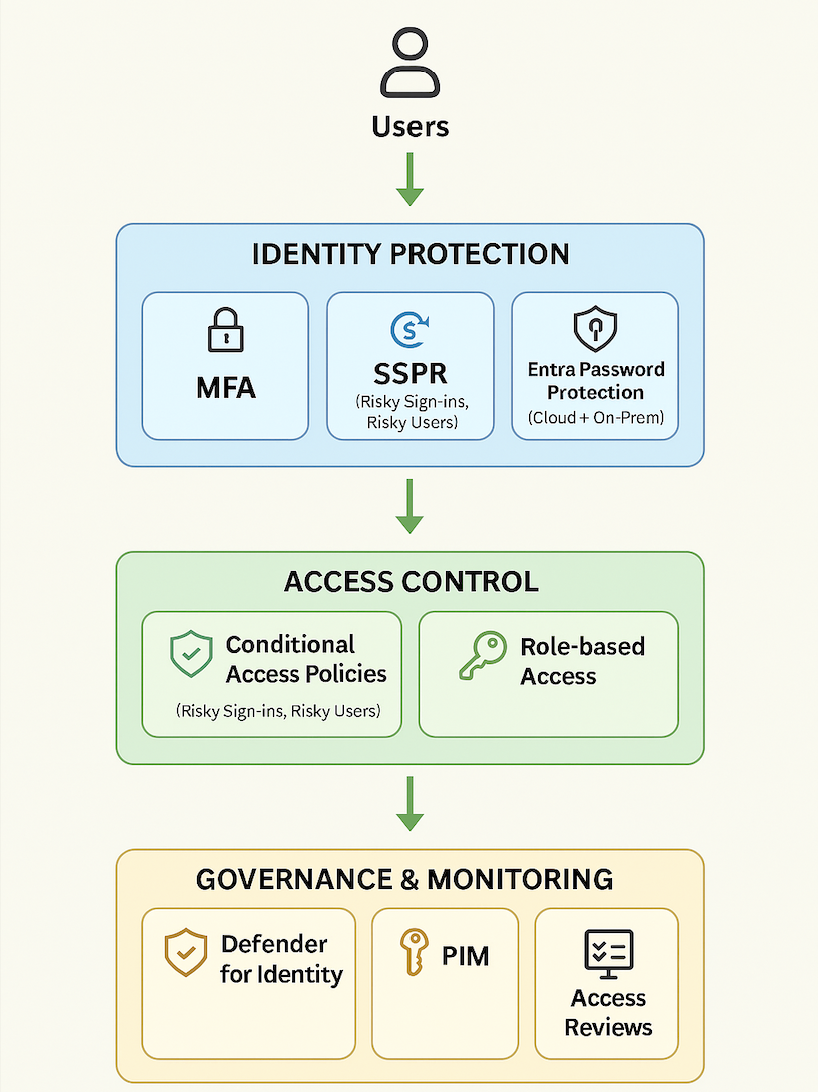
- Enforced Multi-Factor Authentication (MFA) for all users
- Created Conditional Access policies for:
- Risky sign-ins
- Risky user behavior
- Enabled SSPR for secure password remediation
- Deployed Microsoft Defender for Identity across domain controllers
- Installed Entra Password Protection agents on-prem and configured banned password lists
- Activated PIM for just-in-time access to sensitive roles
- Scheduled Access Reviews for role hygiene and least privilege enforcement
Secure Score Architecture Diagram
Impact
- Raised Microsoft Secure Score from 40% to 87%
- Reduced exposure to identity-based threats
- Strengthened hybrid identity posture across Microsoft 365 and on-prem AD
- Improved audit readiness and governance transparency
Relevant Certification
This project aligns directly with the SC-300: Microsoft Identity and Access Administrator certification, demonstrating real-world application of its core objectives.
Since Then
In a subsequent role at a different organization, I have applied the same approach to a separate tenant, where the Microsoft Secure Score currently sits at approximately 93 percent and holds steady in the low nineties. That environment's posture work spans Defender for Cloud, Azure Policy, and conditional access hardening, and is documented separately.